
Seawalls on Lake Sinclair: Georgia Power Rules, Riprap & Permits
A seawall on Lake Sinclair is one of the more tightly controlled things you can build on the shoreline. Georgia Power allows a new one only under specific conditions, requires riprap in front of every new or replacement wall, and sets out what has to happen in the water before an old wall is pulled. Your county gets a say too. This page covers when a new seawall is possible, how replacements and repairs are handled, the materials allowed, filter fabric and silt control, the state buffer exemption written for Lake Oconee and Lake Sinclair, and what walls cost.
The words used on this lake
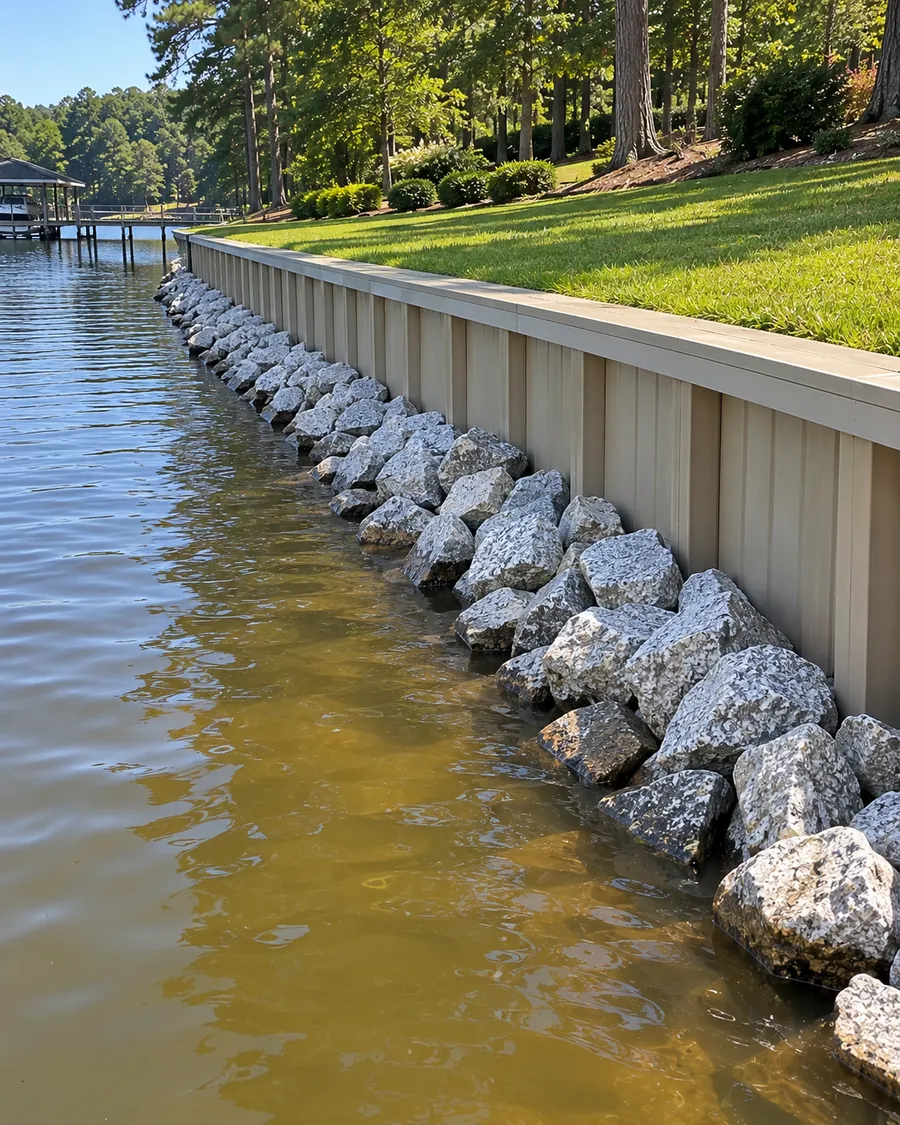
Georgia Power's guidelines for Bartletts Ferry, Jackson and Sinclair lakes call any structure that holds the bank a "shoreline abutment," and they call a wall a seawall. Georgia's state buffer rule uses "bulkheads or sea walls." Whatever your contractor calls it, the same rules cover a timber wall, a vinyl wall and a concrete wall. The first line of the seawall section applies to all of them: "Permission from GPC prior to the installation of any type of shoreline abutment is required."
Georgia Power's FAQ adds that installing or maintaining "any shoreline structure including docks, boathouses, seawalls and shelters" requires "written authorization in the form of a construction permit." That covers repairs as well as new work, and the permit itself is free.
When a new seawall is allowed
Three conditions have to line up before a new wall can go in on Lake Sinclair:
- The shoreline is eroding. "New seawall requests are only permissible on shorelines with evident cut bank erosion." Georgia Power doesn't define the phrase, but a grassy bank that slopes gently into the water is unlikely to meet it, while a bank the water has cut back into a steep or undercut face may.
- There are no wetlands. "Where wetlands are present on a shoreline, no shoreline abutment of any type will be permitted."
- The county will approve it. "Not all counties on Georgia Power lakes can or will approve the installation of new seawalls. This is the discretion of the county, not Georgia Power." A new seawall request also "must provide applicable county and state permits as required."
We didn't find a published seawall rule for Putnam, Baldwin or Hancock county, so call the county building and zoning office for your lot early, before you pay for a design. The permits guide lists each office. If the county won't approve a new wall, ask Georgia Power about the alternatives on shoreline erosion, including stone.
Replacing an old wall
Replacements follow their own set of rules. Where a new seawall replaces an existing one, "the new wall should be in the footprint of the existing wall being removed or in a location acceptable to GPC." In other words, a replacement is not a chance to push the wall out into the lake. The guideline says walls go "as close to existing shoreline as reasonably possible – not in a way to reclaim any 'lost frontage'."
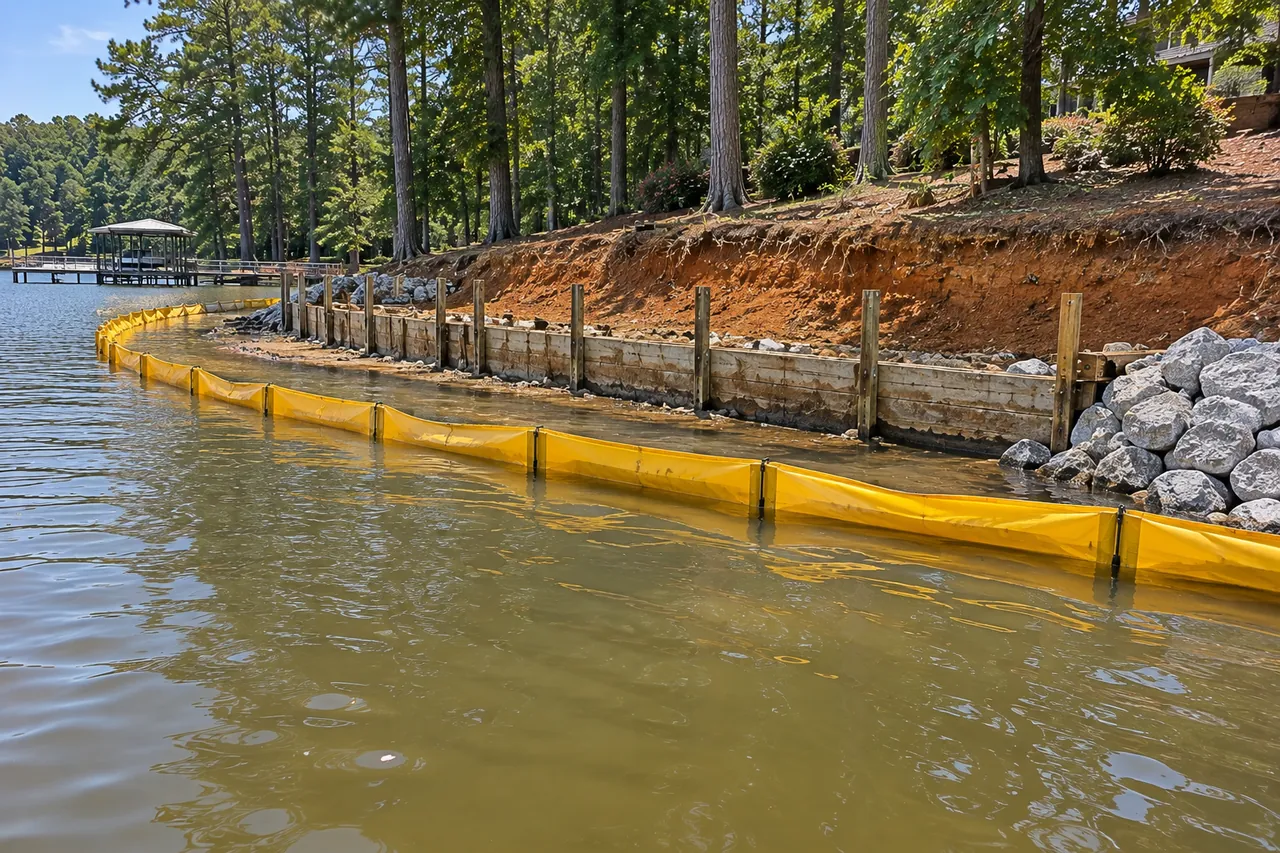
Before the old wall comes out, "A Turbidity barrier is required to be in place," and "This barrier must remain in place until the new seawall is complete." The application has to show where the turbidity or silt screen will go. And the finished job needs stone: "Rip Rap is required on the lakeside of any new seawall or seawall replacement." The riprap guide covers that part in detail.
Repairing a wall you already have
Repairs still go through Georgia Power. Its guideline says "GPC will review maintenance applications and issue permits for work that qualifies as minor maintenance." If your wall was permitted years ago and no longer matches today's rules, "Previously permitted structures that no longer conform with current GPC guidelines can be maintained with minor repairs only." Georgia Power doesn't publish a list of repairs that need no permit, and its FAQ says, "If in doubt, please contact your respective Land Management office."
Big repairs can bring in the riprap rule as well: stone "may also be required on seawalls needing extensive repairs." If a contractor describes a repair as rebuilding most of the wall, ask Georgia Power whether it will be treated as a replacement before you agree on a price.
Materials Georgia Power accepts
"Constructed seawalls can be wood, concrete, block (filled with concrete), bioengineered or vinyl." The guideline doesn't rank them, though it does say Georgia Power "encourages the installation of rip-rap seawalls" because they stabilize the shoreline, provide aquatic habitat, and typically need less disturbance to install and less long-term maintenance than other options.
For national price comparisons, HomeAdvisor's seawall guide (no data year shown on the page) lists wood at $150 to $500 per linear foot, vinyl at $200 to $600 per linear foot for a five-foot-tall wall, concrete at $200 to $800, and riprap at $70 to $400. Ask each contractor what material they recommend for your bank and why, how long they expect it to last, and what maintenance it will need.
Filter fabric, backfill and silt fence
A wall is only as good as the soil it holds. "Installation of filter fabric material behind most seawall types is required." The fabric lets water drain through the wall while keeping soil from washing out behind it. The guideline doesn't list which types are excepted, so get the answer for your material from the Land Management office.
Once the wall is up, "every new wall must be backfilled and stabilized with silt fence, straw and other best management practices" before the job is complete. "Silt fence should be removed after reestablishment of vegetation," so someone has to come back for it. And "A landscape or mitigation plan may be required for any newly constructed seawall." Each of these is a line item. Make sure the quote says who handles it.
The state buffer and the Lake Sinclair exemption
Georgia keeps a 25-foot buffer along state waters, and projects that encroach on it can need a variance from the Environmental Protection Division (EPD). EPD's buffer variance rule, Rule 391-3-7-.05, has a list of activities that "do not require application to or approval from the Division." That list includes the "construction of bulkheads or sea walls on Lake Oconee and Lake Sinclair where required to prevent erosion at the shoreline." It appears in the rules document EPD posts (amended effective September 5, 2013) and in the current rule text, last amended effective May 30, 2022.
That is genuinely specific to this lake and Lake Oconee. But read it carefully:
- It covers seawalls and bulkheads built "where required to prevent erosion at the shoreline." It doesn't mention riprap on its own, or walls built for other reasons.
- It concerns EPD's buffer variance process. It doesn't replace Georgia Power's permit, the county's permits, or the requirement that a new seawall request include county and state permits "as required."
- Georgia Power still says seawall construction "should minimize disturbance within the state waters buffer to maximum extent practicable," and its guideline makes the permit holder responsible for getting all applicable permits before any work inside the 25-foot vegetative buffer or on Georgia Power land.
- Georgia Power's dredging checklist protects "The State of Georgia's 25 foot vegetative buffer or County buffer, whichever is greater," so ask your county whether it keeps a wider one.
Before you rely on the exemption, ask your county's Local Issuing Authority, and EPD if there's any doubt, whether it covers your project.
Timing a seawall job
Georgia Power's Sinclair guideline sets no season for seawall work. The lake normally sits at full pool, so the base of a wall stays underwater most of the year. Georgia Power scheduled a homeowner maintenance drawdown of about five feet starting October 25, 2025, and Baldwin County Fire Rescue's advisory for that drawdown, passing along Georgia Power's message, reminded owners to get permits before working on seawalls, docks and boathouses. If you want to work during the next one, start the permit early. See drawdowns.
What a seawall costs
No dated Lake Sinclair seawall prices have been published. HomeAdvisor's national guide, which shows no data year, puts a seawall at an average of $25,000, with most homeowners spending $15,000 to $60,000, and $100 to $800 per linear foot for the average residential project. Worked out at that per-foot range:
- 60 feet of wall: $6,000 to $48,000
- 100 feet of wall: $10,000 to $80,000
- 150 feet of wall: $15,000 to $120,000
On Lake Sinclair, a new or replacement wall also needs riprap on the lake side, so expect it as its own line on the quote, along with the turbidity barrier, filter fabric, silt fence and straw, and removal of the old wall if there is one. For repairs, Angi's riprap guide lists seawall repair at $100 to $250 per linear foot. A local per-foot price for Lake Sinclair: [PRICE]. The cost guide has the rest.
Questions to settle before a seawall job
- Has the county confirmed it will approve a new wall on this lot, and which county permits apply?
- Who submits the Georgia Power application, and who talks to the Land Management Specialist?
- Is the replacement wall drawn in the old wall's footprint?
- Is riprap on the lake side included, and how much?
- Is filter fabric going behind the wall, and what kind?
- When does the turbidity barrier go in, and who takes it out after the wall is done?
- Who installs, checks and later removes the silt fence?
- Does the job need a landscape or mitigation plan, and who writes it?
- How will the old wall material be removed and hauled off?
Seawall questions
Can I build a seawall on Lake Sinclair to stop erosion?
Possibly. Georgia Power allows new seawalls only where there is evident cut bank erosion and no wetlands, and your county has to be able and willing to approve one. Riprap on the lake side is required.
Can a new wall go farther out than the old one?
No. A replacement belongs in the footprint of the old wall or a location Georgia Power accepts, and walls can't be placed to reclaim lost frontage.
Is a vinyl seawall allowed?
Yes. Georgia Power lists wood, concrete, concrete-filled block, bioengineered and vinyl as seawall materials.
Do I need a permit just to repair my seawall?
Georgia Power's FAQ says maintenance of any shoreline structure, seawalls included, needs a construction permit. There is no fee. Walls that no longer meet today's rules can get minor repairs only.
Do I need an EPD buffer variance for a seawall on Lake Sinclair?
Georgia EPD's buffer variance rule exempts seawalls and bulkheads on Lake Sinclair and Lake Oconee "where required to prevent erosion at the shoreline" from applying to EPD. Confirm with your county that your wall fits that description, and remember Georgia Power's and the county's permits still apply.
How this site helps
Phone (478) 551-3311 or send the form with your county and the rough length of the wall or eroding bank. A single independent contractor who takes Lake Sinclair jobs gets the request, comes out to look, and quotes the wall and the stone in front of it in writing. You choose whether to go ahead, and the introduction is free.
Related pages
Sources
- Georgia Power, Bartletts Ferry, Jackson & Sinclair Lakes shoreline guidelines (PDF, undated)
- Georgia Power, Shoreline Management
- Georgia Power, Lakes FAQs & Resources
- Georgia Power, East Georgia Lakes (office and county contacts)
- Georgia EPD, Buffer Variance Rules and Definitions, Rule 391-3-7-.05 (amended effective Sept. 5, 2013)
- Ga. Comp. R. & Regs. 391-3-7-.05, current text (Cornell LII; amended eff. May 30, 2022)
- 1st Responder News, Lake Sinclair drawdown advisory (Oct. 23, 2025)
- HomeAdvisor, sea wall cost (national, no data year shown)
- Angi, riprap cost (2025 data, national)
Wall leaning or washing out?
Phone us or use the form to reach a single independent contractor who takes Lake Sinclair jobs. There's no charge for the introduction.