
Riprap on Lake Sinclair: Georgia Power Rules, Seawalls, Permits & Cost
If your bank on Lake Sinclair is cut back by the water, or an old seawall needs replacing, riprap will come up fast. On this lake it isn't only a choice between you and a contractor: Georgia Power's shoreline guidelines decide when stone is required, when a wall is allowed at all, and what has to happen while the work is under way. This guide covers where Georgia Power requires riprap, what it encourages, what its rules leave unsaid, the permits in order, timing on a lake that normally stays full, what riprap costs per foot, and the mistakes that break a written rule.
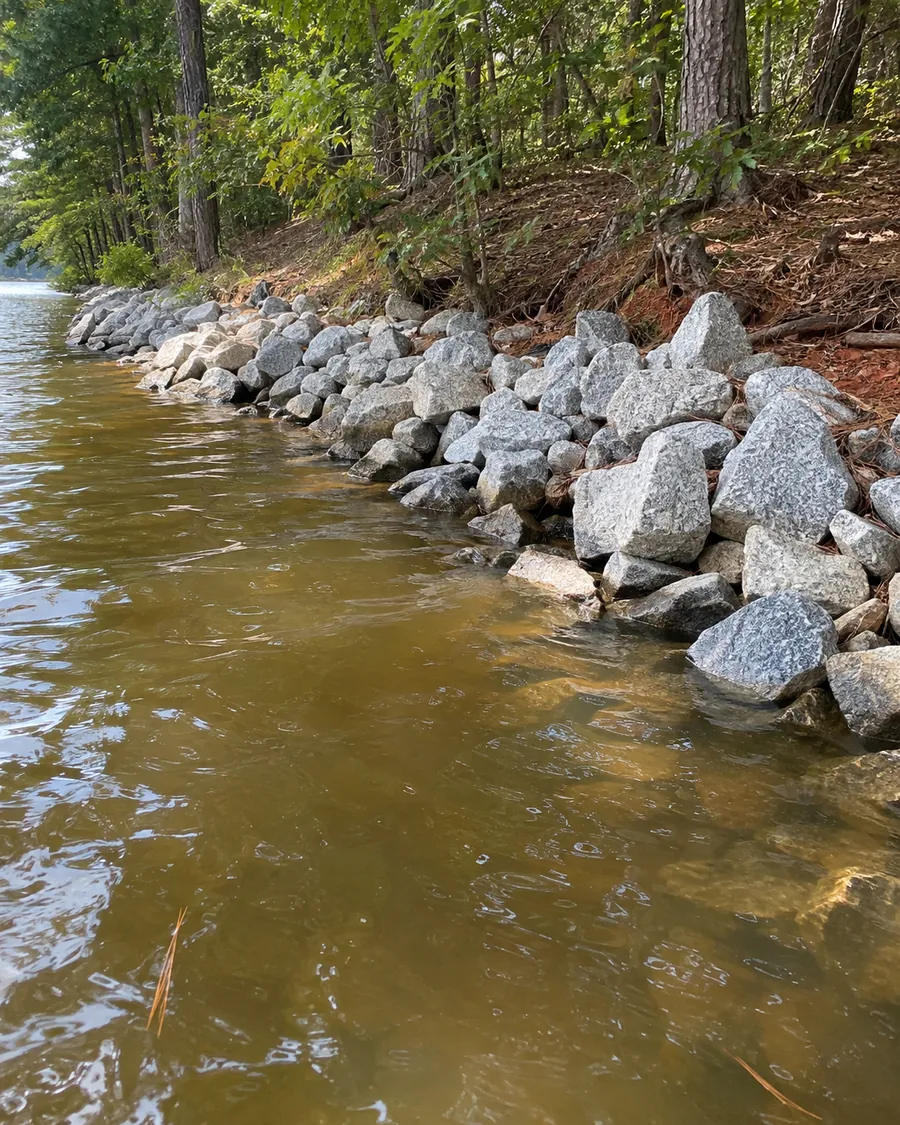
Who decides where stone goes on Lake Sinclair
Lake Sinclair is a Georgia Power hydroelectric lake. Georgia Power's FAQ explains that its operating license from the Federal Energy Regulatory Commission requires it "to control the use of the lakes and the land that Georgia Power owns" that go with the hydro project. That's why owners on deeded lots, not only those on leased lots, are asked to sign a user agreement with Georgia Power.
The rules for Lake Sinclair are in one document: Georgia Power's shoreline guidelines for the Bartletts Ferry lakes, Lake Jackson and Lake Sinclair. Its starting point is simple. "No work can be conducted on GPC property or within the GPC project boundary without prior written approval by GPC." The seawall section says the same thing about shoreline protection specifically: "Permission from GPC prior to the installation of any type of shoreline abutment is required." Riprap laid along a bank is shoreline protection, so plan on a Georgia Power permit before any stone is delivered.
Two more conditions come before any of the engineering. Georgia Power won't issue a permit of any kind to an applicant who isn't a party to a current, valid agreement with it or who is behind on the fees tied to that agreement. And the guideline is undated and says only that it is "subject to revision," so the version on Georgia Power's site when you apply is the one that counts.
Where Georgia Power requires riprap
Most lake rules tell you where stone is allowed. Georgia Power's Sinclair guideline goes further and tells you where it's mandatory:
- In front of every new seawall. "Rip Rap is required on the lakeside of any new seawall or seawall replacement."
- In front of every replacement seawall, under the same sentence.
- Sometimes in front of a repaired wall. Riprap "may also be required on seawalls needing extensive repairs." The guideline doesn't define extensive, so ask the Land Management office before you assume a big repair can go without stone.
In practice, that means a seawall job on Lake Sinclair is also a riprap job. When you compare quotes for a new or replacement wall, check that each one prices the stone on the lake side, not just the wall. Seawalls on Lake Sinclair covers the wall itself.
Riprap on its own: what Georgia Power calls a rip-rap seawall
Georgia Power goes out of its way to favor stone. Its guideline says: "Georgia Power encourages the installation of rip-rap seawalls as they are highly effective at stabilizing shoreline and providing aquatic habitat and typically require less disturbance upon installation and less long-term maintenance comparative to other options."
The guideline doesn't define a rip-rap seawall, and it doesn't say whether every condition for a new seawall applies to a shoreline protected only with stone. Its separate list of seawall materials (wood, concrete, block filled with concrete, bioengineered, or vinyl) doesn't include riprap. If you want stone without a wall, ask the Land Management office two questions before anyone draws a plan: does an all-stone shoreline count as a new seawall for the "evident cut bank erosion" test, and does it still need county and state permits sent in with the request?
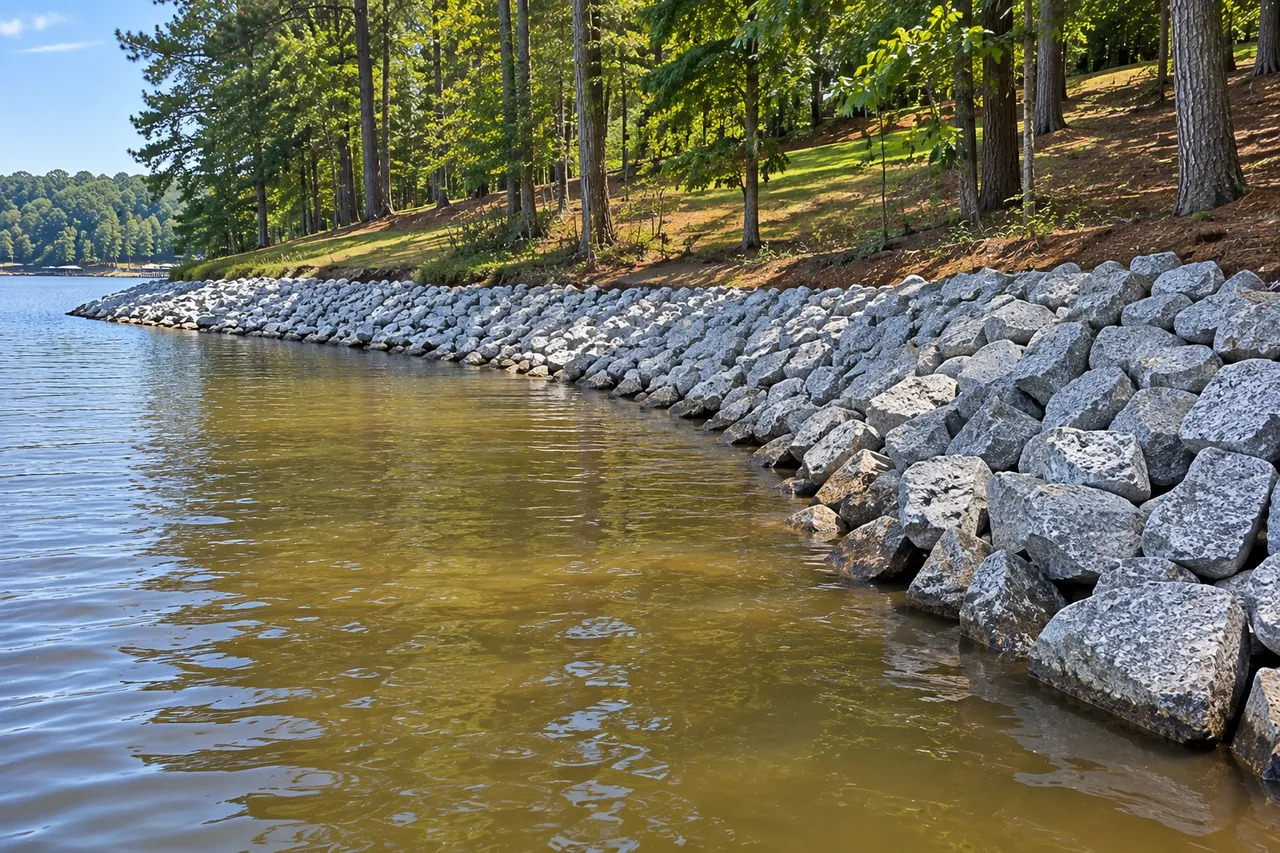
The conditions that apply to any wall or stone
These come from the seawall section of Georgia Power's guideline. Treat them as the first screen for any shoreline protection on your lot:
- Erosion first. "New seawall requests are only permissible on shorelines with evident cut bank erosion."
- No wetlands. "Where wetlands are present on a shoreline, no shoreline abutment of any type will be permitted." That's any type, stone included.
- County and state permits. New seawall requests "must provide applicable county and state permits as required."
- The county can say no. "Not all counties on Georgia Power lakes can or will approve the installation of new seawalls. This is the discretion of the county, not Georgia Power."
- Stay on the old line. Walls go "as close to existing shoreline as reasonably possible," and not in a way that reclaims "lost frontage." A replacement belongs in the footprint of the old wall or in a location Georgia Power accepts.
- Protect the buffer. Seawall construction "should minimize disturbance within the state waters buffer to maximum extent practicable."
- Planting may be part of it. "A landscape or mitigation plan may be required for any newly constructed seawall."
The guideline also tells applicants to "consult with your Georgia Power Lake Resources representative when requesting a permit." On Lake Sinclair that means the Land Management Specialist for your county. Shoreline erosion explains what cut bank erosion looks like.
What the rules specify, and what they leave to the plan
Georgia Power's Sinclair guideline is specific about process and silent about the stone itself. Here is what it says, and where it says nothing:
Georgia Power's Sinclair guideline, line by line
- Riprap location
- Required on the lake side of any new or replacement seawall; may be required for extensive repairs
- Stone size
- Not stated in the guideline
- Slope and toe
- Not stated in the guideline
- Length per permit
- Not stated in the guideline
- Filter fabric
- Required behind most seawall types; nothing stated for stone alone
- Turbidity barrier
- In place before an existing seawall is removed, and kept until the new wall is complete; its location goes on the application
- Backfill
- Every new wall backfilled and stabilized with silt fence, straw and other best management practices before completion
- Silt fence
- Removed after vegetation reestablishes
- Planting
- A landscape or mitigation plan may be required for a new seawall
Because Georgia Power publishes no stone size, slope or toe detail for Lake Sinclair, those numbers have to come from the plan you submit and the contractor's written quote. Ask for them in writing: the size range of the stone, how thick the layer is, the finished slope, how far the stone reaches into the water and along the shore, what goes underneath it, and how the bottom edge is set. If two quotes describe the job differently, those are the lines to compare.
Filter fabric and turbidity barriers
Filter fabric is a geotextile laid between soil and the wall or stone. It lets water drain through while holding the soil back, which is how a wall avoids losing the ground behind it. Georgia Power's rule is direct: "Installation of filter fabric material behind most seawall types is required." The guideline doesn't say which types are excepted, so confirm with the Land Management office whether fabric is required for your wall, and ask the contractor what will sit under any stone.
A turbidity barrier is a curtain set in the water around the work to hold stirred-up sediment in place. Georgia Power requires one "to be in place before the removal of an existing seawall," and it "must remain in place until the new seawall is complete." The application has to note where the turbidity or silt screen will go. Fabric and barriers both cost money, so make sure they're written into the quote rather than left as assumptions.
The permits, in the order they happen
- Read the guideline. Georgia Power's own first step is to read the Bartletts Ferry, Jackson and Sinclair guidelines, which are linked below.
- Give Georgia Power your lot information. Its shoreline page asks every homeowner to submit property information, and says a valid Georgia Power permit is needed for any activity on Georgia Power land. You have to be a party to a current agreement with Georgia Power and current on its fees.
- Apply to Georgia Power. Use the online application, or print it and mail or fax it to the Land Management office. For Lake Sinclair that's the East Georgia (Oconee/Sinclair) Resources Office, 125 Wallace Dam Road NE, Eatonton, GA 31024, phone 706-484-7500, fax 706-317-6048, open weekdays by appointment only. Georgia Power's FAQ says "There are no fees associated with a construction permit."
- Contact the county. "The permittee is responsible for contacting their Local Issuing Authority (LIA) for the county in which the work is proposed." Putnam, Baldwin and Hancock each have their own building and zoning office; the permits guide lists them.
- Check the state buffer. Georgia EPD's buffer variance rule, Rule 391-3-7-.05, says the "construction of bulkheads or sea walls on Lake Oconee and Lake Sinclair where required to prevent erosion at the shoreline" doesn't require an application to EPD. The current rule, last amended effective May 30, 2022, still includes that line. It names bulkheads and seawalls, not riprap alone, so ask your county, and EPD if needed, how it applies to a stone-only shoreline.
- On the job. Turbidity barrier up before an old wall comes out, filter fabric behind the wall, riprap on the lake side, and silt fence and straw until the ground is stable.
The Georgia Power permits guide covers dock, dredging and building permits too.
Timing on a lake that stays full
We found no time-of-year limit on riprap or seawall work in Georgia Power's Sinclair guideline. The only calendar rules in it are for swim buoys, allowed from Memorial Day through Labor Day, and herbicide treatments, which applicators may not carry out on weekends or federal holidays. Georgia Power also publishes no processing time for a permit, so ask the Land Management office when you apply.
The water level matters more than the calendar. Visit Milledgeville describes Lake Sinclair as always full: Georgia Power generates power by pumping water between Lake Oconee and Lake Sinclair, and because Sinclair is downstream, it has to stay at full pool to reach the pumps. With the lake at full pool, the base of a seawall sits underwater most of the time. Georgia Power has scheduled homeowner maintenance drawdowns: in 2020 to a target of 335 feet above mean sea level, five feet below full pool, and again from October 25, 2025, when the lake was expected to drop about five feet. Those windows are when the foot of a wall and the bottom edge of a stone shoreline are easiest to reach. Georgia Power hasn't published the date of the next one, and the permit rules still apply during a drawdown. See Lake Sinclair drawdowns.
Getting stone to the bank without breaking the clearing rules
Access is where shoreline jobs often cross a line without anyone meaning to. Georgia Power's guideline says that "to protect the 25' vegetative buffer and GPC project lands, no mechanical clearing (e.g., grubbing or changing the existing land contour) will be permitted without prior written approval from GPC." It also puts the job of getting every applicable permit before work starts inside the 25-foot buffer or on Georgia Power land on the permit holder, and it prohibits unauthorized clearing of project lands or within 25 feet of the shoreline, whichever is greater, on undeveloped lots. When tree cutting is allowed, Georgia Power's shoreline page says it "requires replanting at a 1:1 ratio." A single walkway path to shoreline structures is allowed on Georgia Power land, no more than 4 feet wide.
Ask any contractor how the stone and equipment will reach your shoreline, whether from the yard or from the water, what has to be cut or moved to make room, and whether that's covered by the permit. Clearing that seems minor on the day can turn into a violation and a replanting bill.
What riprap costs
No dated Lake Sinclair riprap price has been published, so the figures here are national. Angi's riprap guide, labeled 2025 data, gives a spread of $70 to $400 for each linear foot of shoreline. It puts the typical job at about $20,000, says totals often land between $10,000 and $30,000, and describes a common project as 100 to 300 feet long. The top of that spread is for hard sites: Angi names shorelines with several trees, steeper slopes, or bigger water with more wave energy. Multiplied out for three shoreline lengths:
- 100 feet of bank: $7,000 at the low rate, $40,000 at the high rate
- 150 feet of bank: $10,500 at the low rate, $60,000 at the high rate
- 200 feet of bank: $14,000 at the low rate, $80,000 at the high rate
Angi puts the stone itself at $20 to $110 a ton, and filter fabric anywhere from about $45 for a small 40-foot roll to over $3,050 for a heavy-duty 300-foot roll. It also gives building permits at $525 to $3,050 nationally, but that doesn't match the Georgia Power side of a Sinclair job, since Georgia Power charges nothing for a construction permit. County fees are a separate question: [PRICE]. A local per-foot figure for Lake Sinclair: [PRICE]. The cost guide adds seawall, dock and lift costs.
Where riprap and seawall jobs go wrong
Each of these breaks a written Georgia Power rule. Check for them before work starts:
- Stone or a wall goes in before Georgia Power's written approval.
- A replacement wall is built with no riprap on the lake side.
- An old wall is pulled out before the turbidity barrier is in the water, or the barrier comes out before the new wall is done.
- The new wall is set farther out than the old one to gain back yard.
- Filter fabric is left out behind the wall.
- Equipment grubs or regrades inside the 25-foot buffer without Georgia Power's written approval, or trees come down without approval and 1:1 replanting.
- Work goes ahead on a shoreline with wetlands, where no abutment of any type is allowed.
- The county side is skipped, even though a new wall needs county and state permits as they apply.
- The backfill is left bare instead of stabilized with silt fence, straw and other erosion controls.
When riprap isn't the right fix
- Wetlands on the shoreline. No shoreline abutment of any type is permitted there.
- A bank that's holding. Georgia Power wants shorelines "filled with a mix of native trees, shrubs and perennial plants," and new seawalls need evident cut bank erosion. See shoreline erosion.
- You want a beach. "Man-made beaches are NOT allowed along the shoreline or on Georgia Power property," and no sand may be added to an existing natural beach.
- You want more water at the dock. That's a dredging permit, with its own rules: Georgia Power can permit up to 500 cubic yards per property, a certified survey is needed above 400 cubic yards, and a turbidity barrier goes in the lake.
- You want back the land you've lost. A new wall can't be placed to reclaim lost frontage.
Licensing for shoreline work in Georgia
Georgia requires a state residential or general contractor license for contracting work over $2,500, according to the City of Fayetteville's summary of the state law (Senate Bill 115, amending O.C.G.A. Title 43, Chapter 41). Some specialty trades are exempt, and we found no Georgia license category specifically for seawall, dock or riprap work. Ask any contractor which Georgia license they hold for the job, then look it up on the Georgia Secretary of State's website. Each contractor is responsible for their own licensing and insurance, along with permits, pricing and warranties. More questions worth asking are on who does the work.
Riprap questions
Is riprap required in front of my seawall on Lake Sinclair?
For a new wall or a replacement, yes. Georgia Power's guideline requires riprap on the lake side of both, and it may also require stone where a wall needs extensive repairs.
Can I put riprap on my bank without building a wall?
Georgia Power encourages what it calls rip-rap seawalls, but you still need its permission before any shoreline abutment goes in, and none is allowed where wetlands are present. Ask the Land Management office whether the cut bank erosion test and the county and state permit requirement apply to stone alone on your lot.
How big does the stone have to be?
Georgia Power's Sinclair guideline doesn't give a stone size, slope or toe depth. Get those details from the contractor in writing and make sure they match the plan you submit for the permit.
Does the permit cost anything?
Georgia Power's FAQ says there are no fees for a construction permit. Fees for user agreements vary by lake and ownership rights, and any county permit fees are separate.
Can a contractor apply for the permit for me?
Georgia Power issues permits only to a property owner or applicant who is a party to a current agreement with it. Its Lake Sinclair dwelling application, for example, has fields for the contractor's name, phone and email, but neither that form nor the guideline says who may sign. Ask the Land Management office before you hand the paperwork off.
How this site helps
Phone (478) 551-3311 or fill in the request form with your county or nearest town and a rough length of bank or wall. We send it to a single independent contractor who takes Lake Sinclair jobs, who can walk the shoreline with you and quote the stone in writing. Whether to hire them is up to you, and there's no fee for the introduction.
Related pages
Sources
- Georgia Power, Bartletts Ferry, Jackson & Sinclair Lakes shoreline guidelines (PDF, undated, "subject to revision")
- Georgia Power, Shoreline Management
- Georgia Power, online shoreline application
- Georgia Power, East Georgia Lakes
- Georgia Power, Lakes FAQs & Resources
- Georgia Power, Lake Sinclair Residential Dwelling Permit Application (PDF)
- Georgia EPD, Buffer Variance Rules and Definitions, Rule 391-3-7-.05 (amended effective Sept. 5, 2013)
- Ga. Comp. R. & Regs. 391-3-7-.05, current text (Cornell LII; amended eff. May 30, 2022)
- Visit Milledgeville, Lake Sinclair (2020 drawdown notice)
- Milledgeville Messenger, Lake Sinclair drawdown requires permit procedure
- 1st Responder News, Lake Sinclair drawdown advisory (Oct. 23, 2025)
- Angi, riprap cost (2025 data, national)
- City of Fayetteville, GA, contractor licensing requirements
- Georgia ConsumerEd, How can I verify that a contractor is licensed and insured? (Dec. 13, 2023)
Bank caving in at the waterline?
Phone us or use the form to reach a single independent contractor who takes Lake Sinclair shoreline jobs. There's no charge for the introduction.