
Shoreline Erosion on Lake Sinclair: Signs, Rules & Fixes
Shoreline erosion on Lake Sinclair can creep up slowly: a lip of grass hanging over the water, roots showing, a little more soil gone after each windy weekend. Before you pick a fix, it helps to know how Georgia Power will read your bank, because its rules for a new seawall turn on the words "evident cut bank erosion." This page covers what that looks like, what the buffer and clearing rules allow above the water, and the fixes from planting to stone.
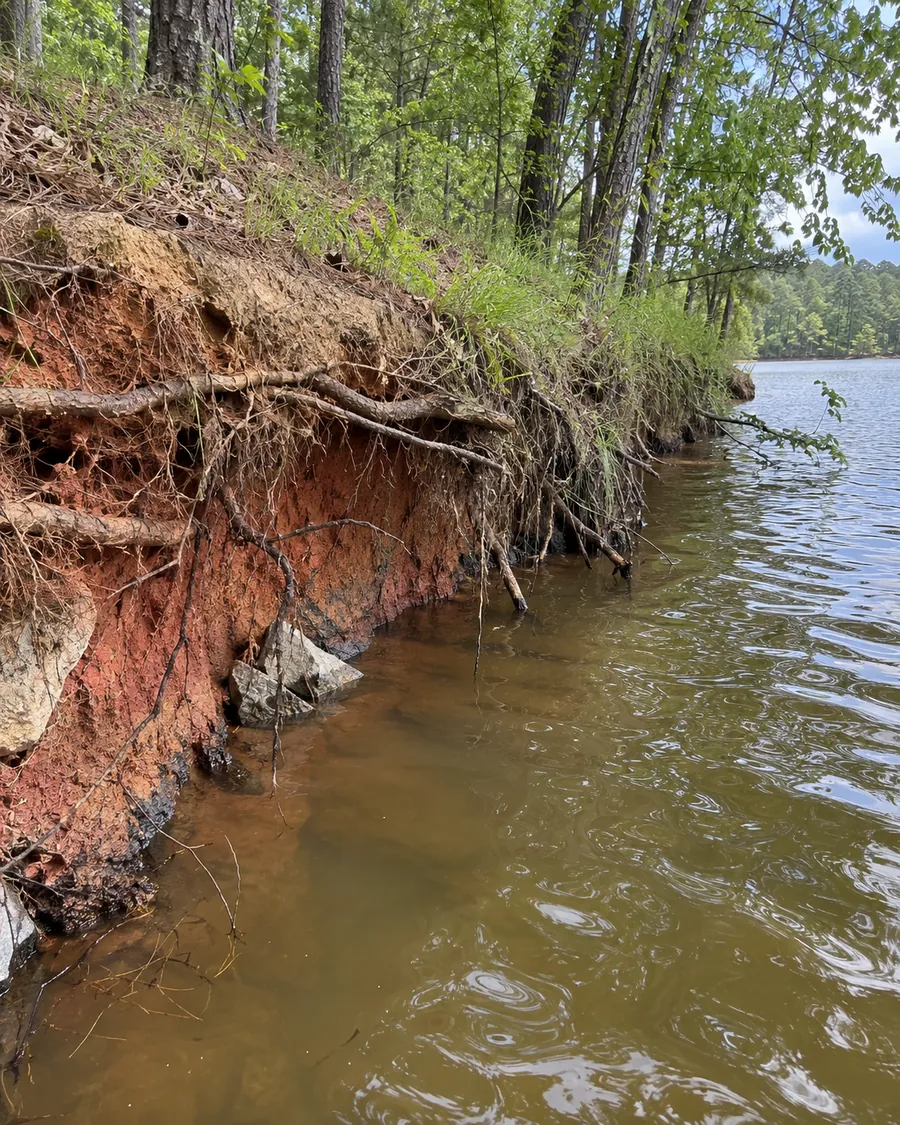
What "evident cut bank erosion" looks like
Georgia Power's guideline for Bartletts Ferry, Jackson and Sinclair lakes says "New seawall requests are only permissible on shorelines with evident cut bank erosion." It doesn't define the phrase. In plain terms, a cut bank is one the water has cut back into a steep or vertical face, rather than a slope that meets the lake gently. Things you might see:
- A near-vertical face of soil at the waterline.
- Turf or roots hanging out over the water, with nothing under them.
- Chunks of bank slumped into the shallows.
- Tree roots exposed along the face of the bank.
- Soil washing out from behind or under an existing wall.
Whether your bank meets the test is Georgia Power's call, and the Land Management Specialist for your county is the person to ask. Photos help. Take them from the water and from the yard, with something for scale, and note roughly how many feet of shoreline are affected.
Why the same band of bank takes the hit
Visit Milledgeville describes Lake Sinclair as always full, because Georgia Power pumps water between Lake Oconee and Lake Sinclair and Sinclair has to stay at full pool to reach the pumps. A lake held near one level means waves meet the bank at about the same height most of the year, so wear can concentrate along that line. The part of the bank below it is usually hidden. The homeowner maintenance drawdowns of about five feet that Georgia Power scheduled in 2020 and fall 2025 were the times owners could see that lower bank and the base of their walls. See drawdowns.
What the rules allow above the water
Before choosing a fix, know what you can't do to the bank on the way. Georgia Power's guideline protects the strip along the water:
- "To protect the 25' vegetative buffer and GPC project lands, no mechanical clearing (e.g., grubbing or changing the existing land contour) will be permitted without prior written approval from GPC."
- The permit holder is responsible for getting every applicable permit before any work starts inside the 25-foot vegetative buffer or on Georgia Power land.
- Unauthorized clearing of Georgia Power's project lands or within 25 feet of the shoreline, whichever is greater, is prohibited on undeveloped lots.
- "When tree cutting is allowed, Georgia Power requires replanting at a 1:1 ratio."
- A single walkway path to shoreline structures is allowed on Georgia Power land, no more than 4 feet wide.
- "Man-made beaches are NOT allowed," and no sand may be added to an existing natural beach.
These rules shape the fix as much as the erosion does. A plan that depends on regrading the bank or clearing a wide path for equipment needs Georgia Power's approval first.
The fixes, from softest to hardest
Native planting
Georgia Power's guideline says "Shorelines should be filled with a mix of native trees, shrubs and perennial plants," and that restoring or maintaining native shoreline plants and trees benefits the local environment. On a bank that is thinning but not yet cut, planting may be the whole answer, and it fits the buffer rules rather than fighting them.
Bioengineered walls
Georgia Power lists "bioengineered" among the seawall types it accepts. Bioengineering generally means combining plants with structural materials so that roots take over the holding job as they grow. It is still a seawall in Georgia Power's terms, so the seawall conditions apply.
Riprap
Georgia Power "encourages the installation of rip-rap seawalls," calling them "highly effective at stabilizing shoreline and providing aquatic habitat" and saying they typically need less disturbance to install and less maintenance than other options. The riprap guide covers what Georgia Power requires and what it leaves to the plan.
Constructed walls
Wood, concrete, concrete-filled block and vinyl walls are allowed where there is evident cut bank erosion, no wetlands, and a county willing to approve them. Every new or replacement wall needs riprap on the lake side. See seawalls.
Where nothing is allowed
"Where wetlands are present on a shoreline, no shoreline abutment of any type will be permitted." If your shoreline is wet and marshy, ask Georgia Power what, if anything, it will allow before paying for a design.
Erosion behind a wall you already have
Soil disappearing from behind an existing wall is erosion too, just hidden. Georgia Power requires filter fabric behind most seawall types now, though an older wall may predate that. Repairs need a Georgia Power permit, which is free, and walls that no longer meet today's rules can get minor repairs only. If the repair is extensive, Georgia Power may require riprap on the lake side. Seawalls explains repair versus replacement.
Who to talk to first
- Georgia Power. The East Georgia (Oconee/Sinclair) Resources Office in Eatonton, 706-484-7500, by appointment. Ask for the Land Management Specialist for your county and whether your bank shows evident cut bank erosion.
- Your county, if a new wall is on the table, since not every county can or will approve one. The permits guide lists Putnam, Baldwin and Hancock offices.
- A contractor, to look at the bank and price the options in writing.
Erosion questions
Is my bank eroding enough for a seawall?
Georgia Power decides. It allows a new seawall only where there is "evident cut bank erosion," which in plain terms is a bank cut back into a steep or undercut face. Photos and a call to your county's Land Management Specialist are the way to find out.
Can I regrade the bank to a gentler slope?
Not on your own say-so. Georgia Power's guideline rules out mechanical clearing, including grubbing or changing the existing land contour, in the 25-foot vegetative buffer unless it gives prior written approval.
Can I cut trees that are falling into the lake?
Ask Georgia Power first. Unauthorized clearing near the shoreline is prohibited, and when tree cutting is allowed, Georgia Power requires replanting at a 1:1 ratio.
Will planting alone stop erosion?
On a bank that is still holding, it may. Georgia Power wants shorelines filled with native trees, shrubs and perennials. A bank already cut into a steep face usually calls for a conversation about stone or a wall.
How this site helps
Phone (478) 551-3311 or send the form, noting about how many feet of bank are wearing away; you can share your photos with the contractor when they call. Your request goes to a single independent contractor who takes Lake Sinclair jobs, who can look at the bank and price the options in writing. The introduction is free.
Related pages
Watching your bank slip away?
Phone us or use the form to reach a single independent contractor who takes Lake Sinclair jobs. There's no charge for the introduction.